Ecology-based
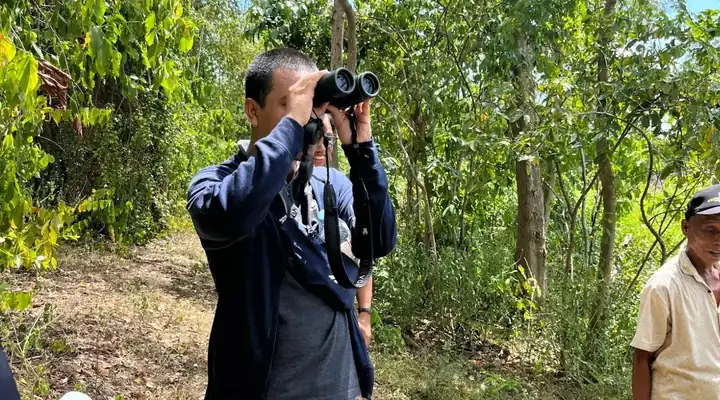
Every intervention starts from field data. Before choosing an intervention, we establish a baseline of biodiversity and of the site’s physical conditions, such as elevation, hydrology, substrate and water quality. Periodic monitoring against indicators set at the outset is used to judge whether an intervention is meeting its objectives, and to adjust it when it is not (adaptive management).
When is restoration considered successful?
According to SER (2004), an ecosystem has recovered when it contains sufficient biotic and abiotic resources to continue its development without further assistance or subsidy. The international standards for ecological restoration (Gann et al., 2019) assess recovery against a reference ecosystem across six attributes: absence of threats, physical conditions, species composition, structural diversity, ecosystem function, and external exchanges with the surrounding landscape. We therefore measure success through biodiversity, vegetation structure and ecological processes (Ruiz-Jaen & Aide, 2005), not the number of seedlings planted.
In practice
- Biodiversity studies and monitoring: flora, fauna, coral reefs and water quality
- Site-suitability assessment before restoration
- Post-intervention monitoring and design adjustment
- Scientific publication of study results, with the data owner’s permission
Programme examples
Coastal and Marine Biodiversity Reserve Lembung Paseser →Coral Transplantation, Gili Genting →Miyawaki Forest PEPC JTB →
Nature-based Solutions
“Restoring a landscape is less about technical solutions and more about cultivating the right relationships. You don’t need to control everything – just create the conditions for others to contribute, connect, and grow.”Nature-based solutions are actions to protect, sustainably manage and restore natural or modified ecosystems that address societal challenges effectively and adaptively, such as coastal erosion, while benefiting biodiversity and human well-being (IUCN, 2020). Our designs are fitted to site characteristics, and their effectiveness is assessed through monitoring rather than assumed.
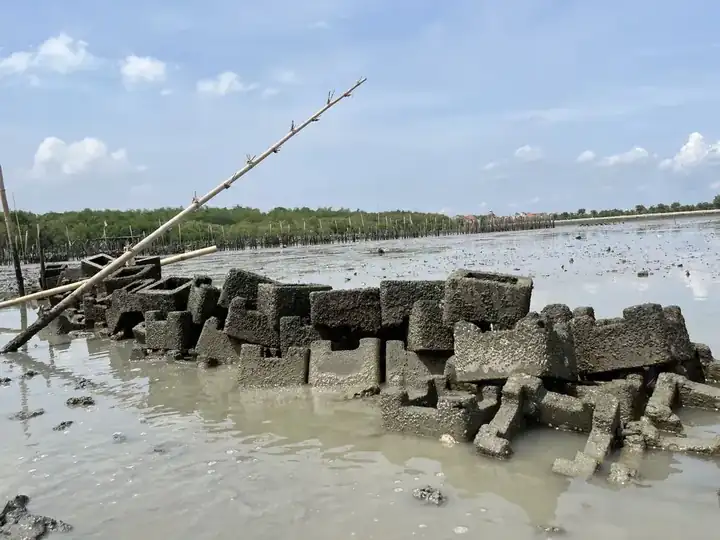
We also read this ecologically. Technical interventions are still needed, but we design them as triggers rather than end results: structures that dampen waves and hold sediment create the conditions for oysters, mangroves and other species to arrive, connect and grow (Chowdhury et al., 2021).
In practice
- POSH (Pervious Oyster Shell Habitat) oyster reef structures made from waste oyster shells in the intertidal zone
- Oyster castles of Agrie Conservation’s own design, inspired by the modular oyster reef units developed by Allied Concrete Company with The Nature Conservancy in Virginia, USA (2007); run as a self-funded programme
- Permeable structures (hybrid engineering) of bamboo poles and brushwood to dampen waves and trap sediment ahead of mangrove planting
- Mangrove restoration based on site-suitability assessment
Programme examples
ORCCA — Oyster Reef Mengare →Oyster Castle Mengare →PRPM Mengare →
References: Chowdhury, M.S.N. et al. (2021). Ecological engineering with oysters enhances coastal resilience efforts. Ecological Engineering 169: 106320. · Gann, G.D. et al. (2019). International principles and standards for the practice of ecological restoration, 2nd ed. Restoration Ecology 27(S1): S1–S46. · IUCN (2020). IUCN Global Standard for Nature-based Solutions. Gland: IUCN. · Ostrom, E. (2009). A general framework for analyzing sustainability of social-ecological systems. Science 325(5939): 419–422. · Ruiz-Jaen, M.C. & Aide, T.M. (2005). Restoration success: how is it being measured? Restoration Ecology 13(3): 569–577. · SER (2004). The SER International Primer on Ecological Restoration. Tucson: Society for Ecological Restoration International.
Social-Ecological Systems
Ecosystems cannot be separated from the people who use and manage them. We analyse resource systems, users and governance together as a social-ecological system, following Ostrom’s framework (2009). The focus is on local institutions, use rules and collective action, which determine whether outcomes last after a programme ends.
In practice
Programme examples
Coastal and Marine Biodiversity Reserve Lembung Paseser →Kalam Mangrove →Mengare Discovery →